Find out more about Float Fishing For Steelhead Techniques And Tackle
Images


Sources
More Sources With Info About Techniques, Michigan, Float Fishing And Center Pin
In high water I fish one-and-a-half the depth of the drift. Doing so guarantees my bait is steadily in the strike zone. If you’re to get a good drift your bobber should be pointed downstream. This way you know your bait is being dragged down river. I like using one-oz floats with four or five shot Slinkys in it. As mentioned previous, you’ll find that mending your line is very important in faster goes. This technique shows exactly when the weight reaches the bottom from your mend. By monitoring your float you may want to see the ticking of your slinky on the bottom. This technique slows your presentation, however gains a natural drift. (pautzke.com)
A big disadvantage of regular steelheading methods is the short time that the tempt spends in a fish’s strike zone . In a common situation, the angler casts down and across stream; the current now sweeps the offering across the stream, sooner or later depositing it directly below the angler. Strikes typically come as the tempt passes across stream or now after the drift stops. Unfortunately, this presentation typically moves your tempt so quickly steelhead have little time to see the offering. In addition, the jerky presentation of bottom bouncing is totally unnatural. In low clear water, bottom bouncing will spook fish that may have been taken with a small float, light line and a tiny tempt. (finefishing.com)
Steelhead are as the fish of a 10, 000 casts! Well guess what, if you pick up a float fishing rod with the right presentation and right water conditions and you may be able to turn them into the fish of 10 casts. Why so lots of people look at steelhead as being so hard to catch is beyond me. Majority of people I think just do not understand the species. Steelhead by nature are bread to survive, unlike a salmon, steelhead will enter the river spawn and still live to spawn another day. Why do you think that’s? Why do salmon die and steelhead live? Steelhead EAT! When they enter the river they do not have only one goal in mind like a salmon. (joelsjigs.com)
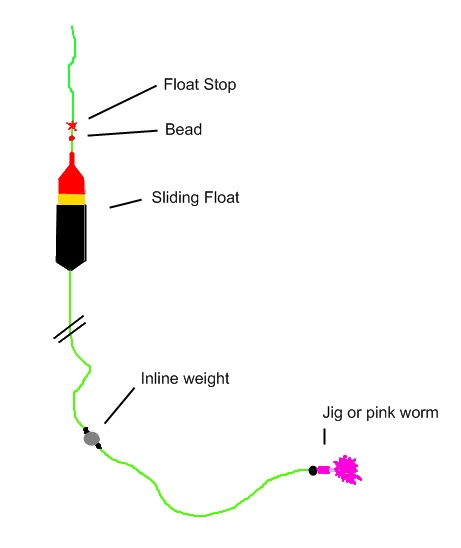
Most float fishermen use a fixed float with about 4-9 feet of line to the bait/tempt. The float should be placed on the major line with the swivel between the float and the bait. The distance below the float to the bait should be adjusted so the bait is just above the bottom. Fixed floats are hard to cast with a bait casting reel. It’s far easier to use a spinning rod to cast the float and jig. Above are two different kinds of floats. The bubble ones on the right are usually called dinks and the line is put in through a tube on the top, then wrapped around the bubble and reinserted into a tube on the bottom. (steelheader.net)
The key river floats is to rig them "top and bottom". This lets the line to be held above or on the surface of the water, making sure that the float may be properly controlled. Rigging floats "top and bottom" requires a small but essential part of tackle called a float cap. A float cap is silicone tubing that’s available in different diameters and colours, either pre-cut or in longer lengths to be cut to size as obliged. The float cap should have a somewhat smaller diameter opening than the stem of the float, so that it holds the float firmly in place. (fishonlineca.com)
To accomplish this you have to mend your line. Mending in hypothesis is simple, however it’s what separates the steeleaders who steadily catch fish from those who don’t. If you cast upstream you will have to reel in the slack as your float drifts towards you. As early as it passes ideally you’ll be able to keep your line out of the water totally – by holding your rod tip up so there’s a bow of line from the top of your bobber to the tip of your rod. Realistically this is frequently not easy to do. The biggest thing to avoid is having a big loop of line dragging in-front of and downstream of your float. (steelheadtips.com)
I’d bet that more anglers have hooked their 1st steelhead by feeding crankbaits downstream than by any other technique. There have been some upgrades in the game, but. The basics involve a ship anchored above a deep hole and a crankbait slipped into the current and allowed to work at the head of the drop-off. After a time, the lures are sent 3 or 4 feet farther downcurrent, and so on till the complete hole was covered. In cold weather you have to take a while working the baits through. Shallower runs and holding regions are better fished a shorter time, frequently with another angler or a guide on the oars rowing, allowing the ship to gradually slip downstream. (outdoorlife.com)
By the way, the float technique may also be used when you want to drift bait in drifts where there’s too much trash on the bottom which will not let a normal drift with a slinky or surgical tubing and lead. The presentation is as normal as the current itself. The major concern with this technique is to get the bait at the correct depth just above the bottom and that the presentation is as natural as possible. The float will have to be moved up or down the mainline or through shortening the leader to correct for the length between the float and bait for a natural presentation. (how-to-fish.com)
You want to fish with a float in medium speed holes; usually 4-10ft based on the species. The wanted speed is going to be walking rate. If your float moves at the speed in which you jog, it can be too fast and a different technique, like drifting, may be more efficient. Most of the time, you’re going to want to fish 1-2ft from the bottom and to find this depth, you ll want to really hit the bottom, reel up, and cut down in 6 inch spurts till your float is not pointing down river or ticking. When casting, you want to cast just above the top of the hole and standing directly across from where you cast. (Visit this link)
In the winter months you may be able to get away with a 1/2 to 3/4 oz slip float and there are many excellent brands out there. Steelhead Stalker, Cleardrift, Thill, and Danielson all make great slip floats for low water winter steelhead fishing. I use lots of the Danielson's because they’re easy on my pocket book, however in reeeeeally low water it's tough to defeat the Cleardrift slip float. At seven bucks apiece they’re spendy, however well worth it if you have to be super sneaky. In summer months you may have to use a much smaller float and you may be able to tweak your setup therefore. (theoutdoorline.com)
Info Form
Optional category of interest:
Email:
Related Posts
- Columbia River Sockeye Salmon Fishing Techniques - What you need to read
Newest Columbia River Sockeye Salmon Fishing Techniques Data Columbia river sockeye salmon trends: River sockeye…
- Steelhead Float Fishing With Baitcaster
Found it - Steelhead Float Fishing With Baitcaster Images SourcesMore Sources With Info About Steelhead…
- Freshwater Fishing Tackle Boxes Soft Tackle Bags - Stuff you should know
Freshwater Fishing Tackle Boxes Soft Tackle Bags 2017 news: Freshwater fishing tackle boxes trends: Fishing…